
LiftMaster Gate Repair in Lancaster: A Homeowner’s Guide
LiftMaster gate repair in Lancaster, CA typically means one of three things: a gate that won’t open, a gate that opens on its own, or a gate that opens but won’t close. Most failures we see trace back to a control board fault, a misaligned safety sensor, or a myQ connectivity issue rather than a dead motor. If you’d rather not take the cover off yourself, call (855) 341-7657 and we’ll diagnose it over the phone before we even schedule the truck.
Here’s the thing most homeowner guides get wrong. LiftMaster operators installed across Lancaster’s neighborhoods over the last eight years are not the same machines your parents had on their driveway gate. The CSL24U, LA400, and LADC series are smart devices with firmware, Wi-Fi radios, and dual-technology safety sensing. When one stops working, the failure mode often lives in software or a sensor circuit, not in the gears. A generalist who treats it like a dumb motor will swap parts until something works. We diagnose by the actual system.
Key Takeaways
- LiftMaster operators fail differently by model: CSL24U boards hate heat, LA400 units trip on current spikes, LADC arms wear at the limit switch first.
- Diagnostic LEDs tell you whether you have a fault code or a lockout state. They are not the same thing.
- myQ connectivity failures are usually Wi-Fi channel or firmware issues, not operator hardware failures.
- Warranty coverage depends on who touches the board. Some repair methods void it immediately.
- Lancaster’s unshaded install locations accelerate heat-related board failures in specific ways.
What Are the Most Common LiftMaster Operators in Lancaster?
Three residential LiftMaster models dominate Lancaster’s gated properties, and each fails in its own pattern. Knowing which one you have changes the diagnosis before we even open the control box.
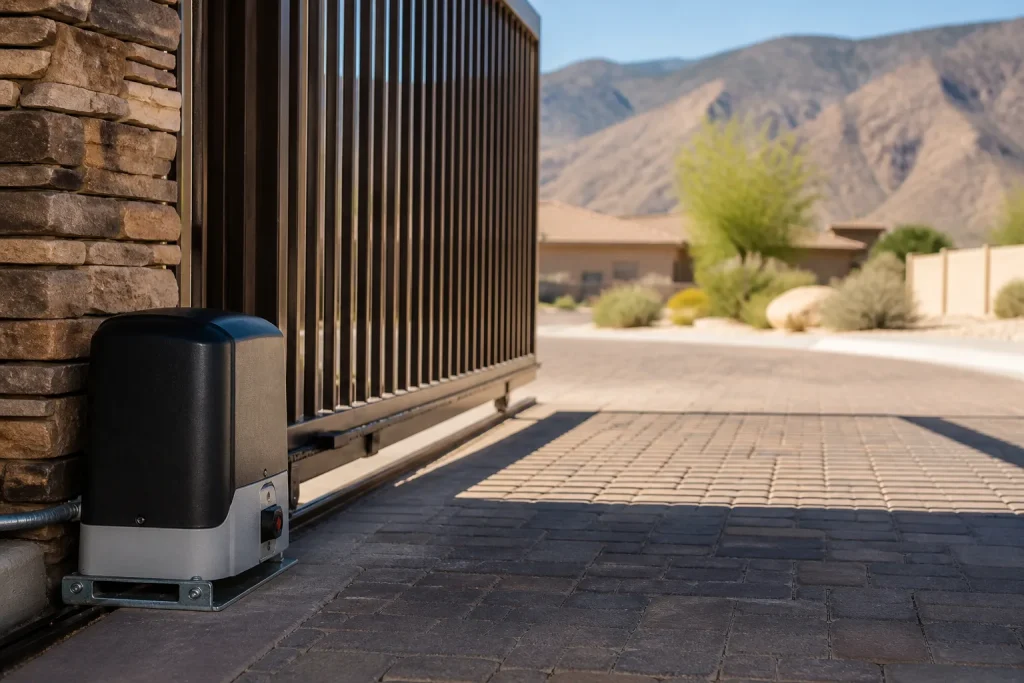
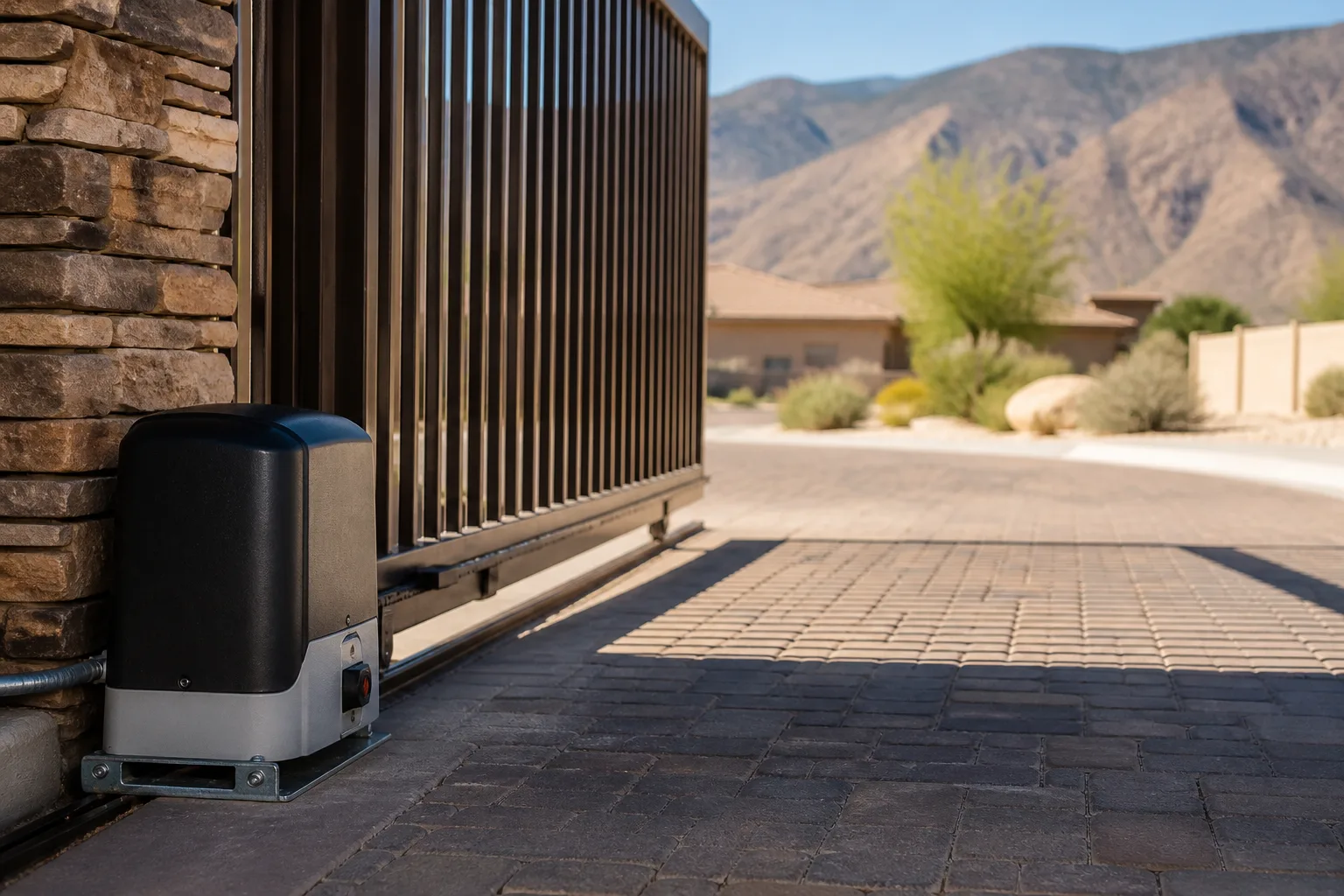
The CSL24U is the slide gate operator we see most often on Lancaster’s newer tract developments. It’s a solid machine, but its control board generates real heat during the summer when the enclosure sits in direct sun with no shade. We replace more CSL24U boards in August than any other month. The board will shut down on thermal overload and recover once it cools, which convinces homeowners the problem sorted itself out. It did not. It will happen again, and the recovery window gets shorter each time.
The LA400 is LiftMaster’s swing gate workhorse. We see these across Lancaster’s older ranch-style properties. Its most common failure is a tripped current sensor after wind gusts catch the gate leaf. The operator senses the resistance and locks out to protect the motor. Homeowners think the gate is broken. Sometimes the fix is clearing the lockout and adjusting the force settings. Sometimes the hinge is binding and the operator is doing exactly what it was designed to do.
The LADC is a linear actuator arm used on smaller swing gates. On these, the limit switch wears gradually. The gate starts opening slightly less than full travel, then eventually stops at about 80 percent. It’s a mechanical wear item, not an electrical fault, and it’s a fast fix when caught early. Left alone, the motor strains against the worn limit and burns itself out.
How to Read LiftMaster Diagnostic Codes Without Guessing
LiftMaster control boards use LED blink sequences to tell you what’s wrong. The key distinction most people miss: a fault code means the board detected a specific condition. A lockout state means the board shut the operator down on purpose to prevent damage or injury. Both look like blinking lights to an untrained eye. They require different responses.
On the CSL24U, a repeating two-blink pattern points to a photo eye obstruction or misalignment. Three blinks indicate a force reversal trigger. Four blinks commonly point to a motor or capacitor issue. But here’s the nuance: after a force reversal or obstruction event, the operator enters a lockout and will not respond to any input until you reset it. If you keep pressing the remote and nothing happens, you may be looking at a lockout state, not a dead operator.
Our advice for Lancaster homeowners: count the blinks, write down the pattern, and call us. We’ll tell you over the phone whether it’s a simple reset or a board-level problem. We do not recommend clearing lockouts repeatedly without addressing the underlying trigger. We’ve seen operators forced into service again and again after obstruction faults, and the boards fail catastrophically within two months. The lockout exists for a reason.
myQ Connectivity: When the Operator Is Fine but the App Says Otherwise
Here’s a scenario we see at least twice a month in Lancaster. A homeowner’s gate works perfectly with the remote and the keypad. But the myQ app says “offline” or “gate not responding.” A generalist will tell them the control board is failing and quote a replacement. The actual problem is usually a Wi-Fi channel conflict or a firmware version mismatch.
LiftMaster’s myQ system connects through your home Wi-Fi. If your router switched to a crowded 2.4 GHz channel or you recently changed your network password or SSID, the operator’s Wi-Fi module loses its connection. The gate still works locally because the hardwired inputs and RF remotes do not depend on Wi-Fi. The myQ module is a peripheral, not the brain. It is also a common casualty of router firmware updates that enable band steering features, which confuse IoT devices that only operate on 2.4 GHz.
Firmware pushes are another culprit. LiftMaster periodically updates operator firmware through the myQ platform. If an update fails mid-install because of a weak signal, the operator can enter a state where it will not connect to the network until the firmware is manually reflashed. That procedure requires opening the control box and using the on-board learn button sequence. It is not a fix we recommend attempting from a YouTube video, because putting the board into the wrong mode can disable the operator entirely.
Our take: if the gate opens and closes normally but the app is unreliable, the operator is probably fine. The problem is the connection layer. We diagnose that in about twenty minutes without replacing a single part.
LiftMaster Warranty Details Most Lancaster Homeowners Miss
LiftMaster residential operators typically carry a limited warranty that covers the motor and gear assembly for a longer term than the control board and accessories. The exact coverage depends on the model and the installation date. We can look up your operator’s warranty status by serial number. What most homeowners in Lancaster don’t realize is that specific repairs void the warranty if done incorrectly.
Opening the control board enclosure and replacing a blown capacitor yourself? That usually voids the board warranty. Installing a non-LiftMaster receiver or splicing aftermarket photocells into the harness? Same problem. LiftMaster’s warranty terms are explicit about unauthorized modifications. We’ve had to deliver that news to homeowners who watched a DIY video, replaced their own board, and lost coverage when the replacement board failed three weeks later.
There is also a nuance with professional installation. A warranty claim for a failed board is far stronger when a LiftMaster-certified dealer performs the diagnosis and documents the failure with the serial number and LED code history. We keep that documentation and submit it with your claim. The homeowner path to warranty service goes through LiftMaster’s phone support, which is workable but slower.
The main rule: do not let anyone who is not familiar with your exact model open the board enclosure. If our technicians on a call from the Lancaster area ever touch your operator, it’s with the understanding that we document everything for warranty preservation.
Heat, Shade, and Lancaster’s Control Board Problem
Lancaster summers push 100°F routinely, and a lot of the newer tract homes in the city were built with the gate operator enclosure installed on a south-facing or west-facing wall with no shade structure. That placement bakes the control board for six to eight hours a day, every day, from June through September.
Heat does two things to LiftMaster boards. First, it degrades electrolytic capacitors. These are the small cylindrical components on the board that smooth out voltage. High heat shortens their lifespan measurably. A board that lives at 140°F inside its enclosure will lose its capacitors two to three years faster than one that lives at 100°F. Second, thermal cycling stresses solder joints. The repeated expansion and contraction from daily heating and cooling can crack solder connections, especially around the relay and transformer mounts. This produces intermittent failures that are hard to pin down because the problem only shows up when the board is hot.
We cannot change the Lancaster climate, but we can move an operator enclosure or add a ventilated sun shield. That simple modification adds years to a control board’s life. When we install new LiftMaster operators in Lancaster’s unshaded areas, we recommend placing the enclosure on a shaded side of the post or installing a standalone sun hood as part of the job.
LiftMaster vs. Other Brands: What We Actually See in the Field
Homeowners sometimes ask us whether they should switch from LiftMaster to another brand when their operator fails. We work on LiftMaster, FAAC, BFT, Linear, and several others, so we can answer that without brand bias. The answer is usually no, but with one important caveat.
LiftMaster’s strength is its residential ecosystem. The myQ platform, the remote compatibility, the parts availability through national supply chains, and the number of installers who know the systems all make it the most practical choice for a Lancaster homeowner with a single-family swing or slide gate. If you already have a LiftMaster operator, replacing it with a different brand rarely makes sense unless you are upgrading the whole gate structure.
The caveat: for heavier commercial-style gates or high-wind areas in Lancaster’s more exposed eastern neighborhoods, we sometimes recommend a FAAC or BFT operator instead. Those Italian-built systems use heavier-duty gearboxes and hydraulic options that handle continuous wind load better than residential LiftMaster units. But that’s a case-by-case judgment, and for most Lancaster homes, a properly sized LiftMaster is the right machine.
Linear and Viking make solid operators too. Linear’s slide gate units are robust, but their residential parts network is smaller than LiftMaster’s, which means longer waits when something does fail. Viking builds quality products, but we see fewer of them in Lancaster’s residential neighborhoods, and parts familiarity matters when you’re waiting on a fix.
If your LiftMaster operator is under seven years old and your gate structure is sound, repair is usually the right call. A new operator won’t solve a binding hinge or a settling gate post.
When to Call a Pro
Most Lancaster homeowners should call a professional the moment a LiftMaster operator shows any of these signs: repeated lockouts in the same week, a burning smell from the enclosure, a gate that reverses direction mid-travel, or LED codes that change pattern without any input from you. These indicate problems that will not resolve with a reset and tend to get worse quickly.
Safety is the other reason. Gate operators move hundreds of pounds of steel. A misaligned safety sensor can turn a closing gate into a hazard for a child or a pet. Even if you’re comfortable with a multimeter, the safety sensing circuit is not where you want to learn by trial and error. If your gate is closing with too much force or not reversing when it meets resistance, stop using it and call us. That is a genuine safety concern, not a convenience issue.
For related work in Lancaster, our Electric Gate Repair in Lancaster service covers automation and control board diagnostics for all nine brands we service, and our Gate Installation in Lancaster team handles full operator replacements when a repair is not the right financial call. If you’re not sure which path applies to your situation, start with our Gate Repair in Lancaster page for an overview of what we diagnose most often.
The Bottom Line
LiftMaster gate operators in Lancaster fail in predictable, model-specific ways. The CSL24U fights heat. The LA400 fights wind loads. The LADC fights time. The myQ platform adds a connection layer that creates its own failure modes, separate from the electromechanical system underneath. And the warranty on every one of these machines depends on who does the work and how they do it.
If your LiftMaster gate is acting up, start by counting the LED blinks. That number tells us more than a ten-minute description of what happened. Then decide whether it is a call you want to make. If you’re in Lancaster and need help, Gate Repair Lancaster offers free estimates. Call (855) 341-7657 and we’ll walk through the diagnosis before we ever send a technician out.
Frequently Asked Questions
Most LiftMaster gate repairs in Lancaster run between $150 and $450 depending on the part and the labor involved. Board replacements are at the higher end, while limit switch adjustments and sensor realignments cost less. Call (855) 341-7657 for a specific quote on your model. Estimates are free.
In many cases, yes. We stock common LiftMaster parts like limit switches, photo eyes, and capacitors, so we can often complete a repair on the first visit. More complex board-level issues may take one to two days if we need to order a model-specific part. Call us before noon and we’ll do our best to get to you the same day.
This is almost always a phantom signal issue. A failing remote, a stuck button on a keypad, or interference from a nearby device on a similar RF frequency can trigger the operator to open without anyone pressing anything. We’ve also seen myQ scheduling settings set accidentally by a family member through the app. We diagnose this by eliminating each input source systematically.
We work on LiftMaster specifically, along with FAAC, BFT, Linear, Viking, Ghost Controls, DoorKing, Elite, and Mighty Mule. LiftMaster is one of the most common brands we service in Lancaster because it’s the most installed brand in the area. We carry LiftMaster parts and we know the model-specific failure patterns. See our Gate Repair Lancaster home page for the full list of systems we cover.
Written by the team at Gate Repair Lancaster, serving Lancaster since 2015.
Need Gate Repair Help?
Call Gate Repair Lancaster - licensed & insured, here with fast help in Lancaster.
(855) 341-7657