
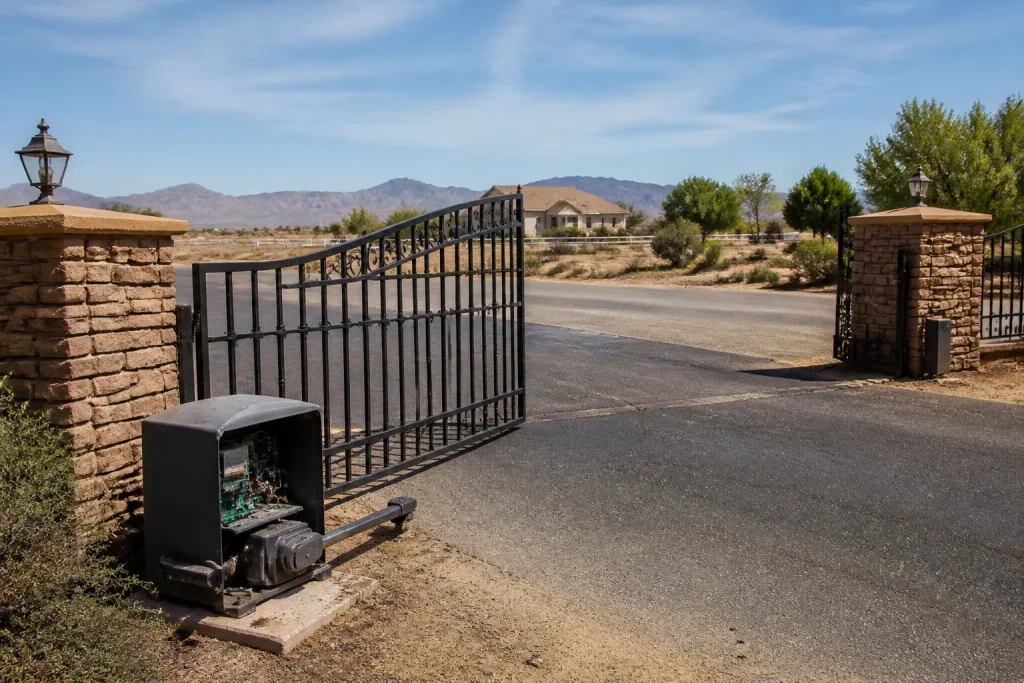
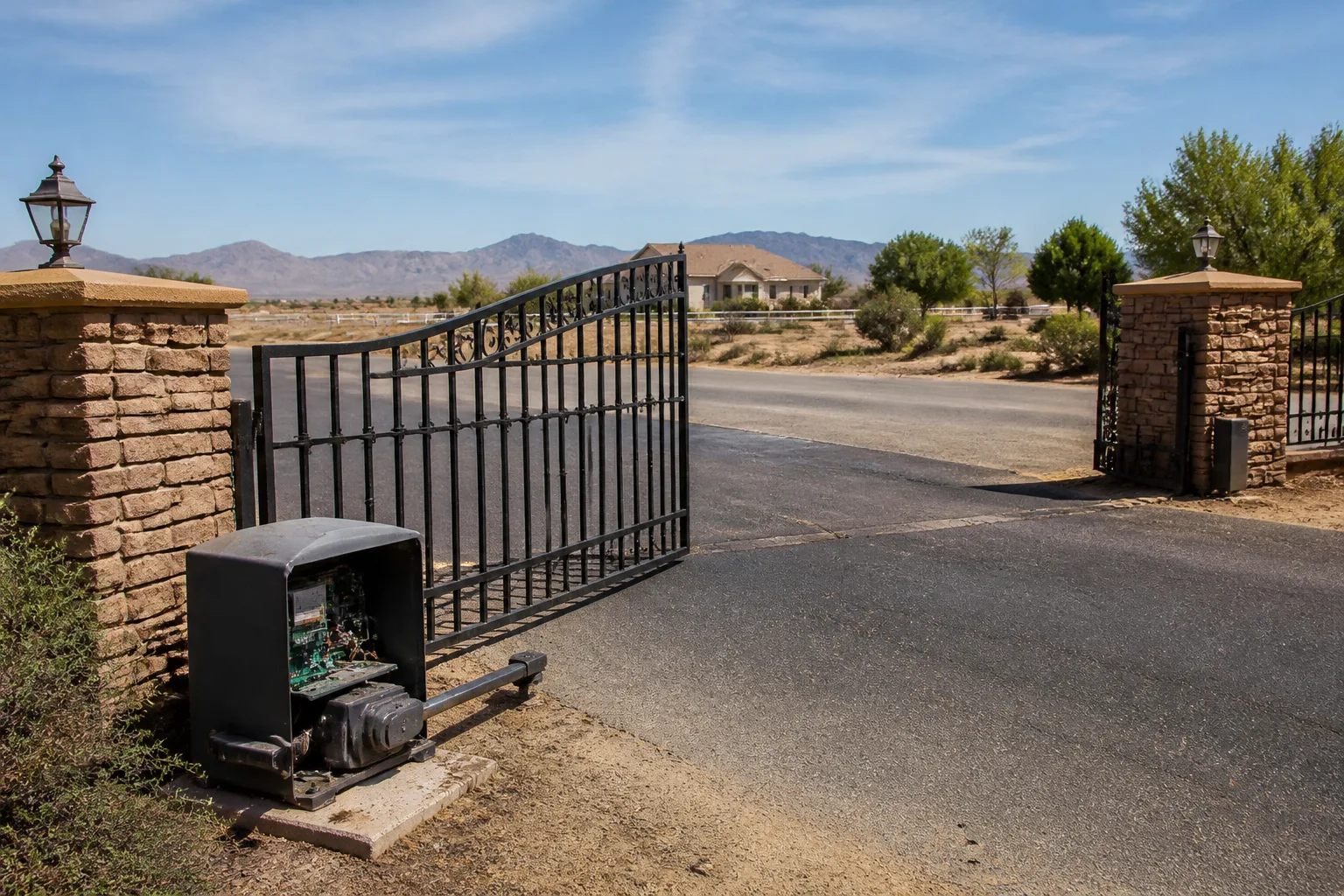
Emergency Gate Repair Near Me: What Lancaster Homeowners Should Do First
A gate that fails in the open position at 11 p.m. or refuses to close as you’re leaving for work isn’t just a nuisance. It’s a security fracture. The first thing to do is stop, assess whether the gate is safe to leave in its current position, and avoid forcing any part of the mechanism. That instinct to yank the gate or pry at the motor housing is exactly what converts a minor fault into a major repair. If you’d rather skip the diagnosis and get someone to your property now, call (855) 341-7657.
The First Five Minutes: A Decision Tree for Lancaster Homeowners
Before you touch anything, answer three questions in order. They’ll tell you whether this is a “handle it in the morning” problem or a “get someone out here tonight” problem.
- Is the gate stuck open or closed? Stuck open is the higher-priority situation, especially if you have children, pets, or visible equipment on the property. A gate stuck open on Avenue J or up in Quartz Hill becomes an invitation after dark. Stuck closed is inconvenient but secure; you can usually wait for a standard appointment.
- Did it fail suddenly or gradually? Sudden failure with no warning usually points to a blown capacitor, a snapped chain, or a control board fault. Gradual decline (slower operation, grinding, intermittent stops) suggests wear on hinges, rollers, or the operator itself. Sudden failures are more likely to strand the gate mid-cycle.
- Is any part of the gate or operator making noise when you press the remote? A hum with no movement usually means the operator is getting power but can’t move the gate, often a capacitor or gear problem. Clicking with no hum points to a relay, receiver, or circuit board issue. Silence usually means a power supply or breaker problem.
If the gate is stuck open, you can’t close it manually, and you have security concerns, that’s a call-you-now situation. If it’s stuck closed but you can operate it manually, you have breathing room to schedule a repair in the next day or two. In our experience across Lancaster, most homeowners wait too long on a gate operating in “degraded mode” and end up with a full failure at the worst possible moment.
How to Safely Engage the Manual Disconnect Without Making Things Worse
Most gate operators have a manual release mechanism designed to let you move the gate by hand during a power outage or failure. The key is knowing which type you have and what the release actually does. Here’s the breakdown for the four most common operator styles we see in Lancaster:
- Padlock-style release (common on LiftMaster and Elite swing operators): A small lever or keyed release on the side of the operator body. Turn it, pull the arm free, and the gate can be pushed manually. Make sure you re-engage it the same way before calling for service so the technician can test the operator under load.
- Chain-drive slide gates (frequent on Mighty Mule and older systems): Look for a disconnect lever near the drive sprocket. Pulling it separates the chain from the motor, allowing manual push. On these, you want to note whether the chain is intact or broken before you touch anything. A broken chain is diagnostic gold.
- Hydraulic swing operators (FAAC, BFT): These typically have a manual release valve on the pump unit, often requiring a small wrench or a flip handle. Open the valve slowly. The gate becomes free-swinging immediately. Don’t stand in the arc of a hydraulic gate when you release it; they can drift fast if the system was under pressure.
- Articulating arm operators (Ghost Controls and similar): A pull-pin or toggle at the arm’s mid-point disconnects the drive. These are straightforward, but you should check whether the arm itself is bent or fractured before re-engaging.
One warning from the field: don’t use bungee cords, zip ties, or lumber to hold a gate in a half-open position while you wait for service. We’ve seen Lancaster homeowners “temporarily” secure a gate with a ratchet strap and have it slip in the wind, bending hinge posts or cracking operator arms. That temporary fix becomes a secondary charge on the invoice.
What to Have Ready Before You Call an Emergency Gate Technician
A good dispatch call takes under three minutes when you have the right information in front of you. Here’s what speeds everything up and gets the right parts on hand the first time:
- The brand and model of your gate operator. Look on the operator housing or remote. It matters. We stock parts for LiftMaster, FAAC, BFT, Linear, Viking, Ghost Controls, DoorKing, Elite, and Mighty Mule, but not every technician carries every part. Knowing the brand means the technician arrives with the right capacitors, control boards, or limit switches.
- What the gate does when you press the remote. Hum? Click? Nothing? Moves a few inches then stops? Each symptom points to a different failure point, and describing it precisely saves a return trip.
- When the problem started and whether it got worse gradually or all at once. That timeline narrows the diagnostic path.
- The gate’s position right now and whether you’ve been able to move it manually. If you’ve released the manual disconnect, say so. The tech needs to know what state the mechanism is in before touching it.
- Any recent work or weather events. High-wind days in Lancaster knock over gate frames and loosen hardware. Power surges hit control boards. If the gate was worked on in the last year by someone else, that’s relevant.
And one more thing: a photo of the operator and the gate in its current position, sent while you’re on the phone, is worth more than five minutes of verbal description. If the company won’t take one or doesn’t care, that’s a signal about who you’re dealing with.
Emergency Gate Tech vs. General Contractor: How to Tell the Difference
Lancaster has no shortage of people who will answer an emergency line at any hour. The question is whether the person on the other end actually knows gates, or whether they’re going to drive out, stare at your operator for twenty minutes, and call someone else. Here’s how to tell within the first ninety seconds of the call:
- A gate specialist asks about your brand immediately. If they say “we work on everything” without asking what brand of operator you have, they probably don’t stock parts for any of them. We ask because Mighty Mule systems don’t fail the way FAAC systems fail, and the parts aren’t interchangeable.
- A specialist can give you a diagnostic range over the phone. “If it hums and doesn’t move, it’s probably a capacitor or gear” is a specialist answer. “We’ll have to come look at it” without any follow-up questions is a service fee waiting to happen.
- A specialist carries parts on hand. General contractors call and order parts after they see the problem. That’s a second visit and a second service fee. Gate-only companies like ours roll with the common failure parts for the nine brands we cover: LiftMaster, FAAC, BFT, Linear, Viking, Ghost Controls, DoorKing, Elite, and Mighty Mule.
- A specialist doesn’t subcontract emergency calls. If the person answering sounds like a call center and says “a technician will reach out to you,” you’re probably paying a markup on top of someone else’s labor.
You don’t need to become a gate expert to make this call. You just need to ask two questions: “What brands do you work on?” and “Do you carry parts on hand?” If the answers are vague, you’re calling a dispatcher, not a technician.
Temporary Security Measures While You Wait
If your gate is stuck open and a technician is a few hours out, here’s what actually helps, and what makes things worse:
What to do:
- Move valuables out of sight. If the gate can’t close, the next best thing is making the property look uninteresting. Lock vehicles, put tools away, close garage doors.
- Use temporary lighting. Motion-sensor lights or even a porch light left on changes the risk calculation for anyone scoping the property. Lancaster’s wide lots and dark side streets make a lit property the exception, not the rule.
- Park a vehicle across the driveway if the gate is the only vehicle access point. It’s not elegant, but it makes casual entry impossible.
- Document the gate’s current state with photos. Time-stamped photos help if there’s any dispute about pre-existing damage and give the technician a reference before arrival.
What not to do:
- Don’t zip-tie the latch or bolt the gate to a post. We see this constantly. The gate then gets hit by wind or an attempted entry, and the stress transfers into the frame, the hinges, or the operator mount. That’s a bigger repair than the original failure.
- Don’t prop the gate with lumber or cinder blocks. Gates are heavier than they look. When the prop slips, the gate swings into a vehicle, a person, or a fence. We’ve repaired a gate over in the Antelope Valley Poppy Reserve area where a homeowner propped a slide gate with a fence post and woke up to it resting against their neighbor’s truck.
- Don’t keep pressing the remote or keypad. Repeated cycles on a failed operator can overheat motors and damage control boards. One press, observe, stop. If it doesn’t respond, leave it alone.
If you need help now, call (855) 341-7657. We’ll walk you through what we can over the phone and get a plan in motion.
Why Brand Matters in an Emergency, Not Just for Routine Work
Here’s the thing most Lancaster homeowners don’t realize until it’s too late: a gate operator isn’t a generic box. A Mighty Mule residential system is engineered differently from a BFT hydraulic unit, and a Ghost Controls articulating arm shares almost nothing with an Elite slide operator. When a repair is urgent, the difference between a technician who knows your exact brand and one who’s going to “figure it out” is time, money, and whether the fix holds.
We focus on gates exclusively. That’s not a marketing line. It means we bring components for the nine major brands we service: LiftMaster, FAAC, BFT, Linear, Viking, Ghost Controls, DoorKing, Elite, and Mighty Mule. It means when someone calls from the Boulevard Park area with a DoorKing slide gate that’s lost its limits, we already know the likely failure points before we arrive. And it means we’re not splitting our attention between fencing, garage doors, and gates. This is all we do.
If your electric gate failed, check out our Electric Gate Repair in Lancaster page for more detail on what’s involved. If the operator is beyond saving and you’re weighing replacement, our Gate Installation in Lancaster page walks through the options.
What a Proper Emergency Gate Repair Actually Costs in Lancaster
Nobody likes a surprise invoice. Here’s what you should expect, based on what we see across Lancaster and the Antelope Valley:
- Emergency dispatch and diagnosis: $75 – $150, depending on time of day and location within Lancaster. This covers the technician’s travel and the diagnostic work, not just showing up.
- Capacitor replacement: $40 – $90 for the part, plus labor. Capacitors are one of the most common failure points on residential swing operators and are usually a same-visit fix.
- Control board replacement: $200 – $500 depending on brand. DoorKing and FAAC boards run higher than Mighty Mule or Ghost Controls. The board is often the second-most-common culprit after capacitors.
- Chain or belt replacement on slide gates: $150 – $350 including parts and labor, depending on gate length and chain grade.
- Operator gear or motor replacement: $250 – $600. When the motor itself is burned out, you’re into the territory where replacing the operator may make more sense than repairing it.
- Full operator swap (residential swing): $800 – $1,800 installed, depending on brand and whether you’re staying with your existing brand or upgrading.
Every quote we provide is agreed before any work begins. You’ll know the number before we turn a wrench. That’s not a policy that shows up in ads; it’s just how the job should be done. And if you’re calling around Lancaster for comparison, ask each company whether their price includes the part or if parts are billed on top. That’s where the gap between a $200 quote and a $400 final bill usually lives.
For a broader look at what goes into gate service in this area, our Gate Repair in Lancaster page covers the full scope, and you can always start at the Gate Repair Lancaster home page to see everything we handle.
When to Call a Pro Immediately
Some gate failures are genuinely dangerous to touch. If any of these apply, don’t attempt a manual release or a DIY diagnosis. Call a specialist:
- The gate came off its track or the hinges are visibly bent or cracked. The weight distribution is now unpredictable, and a falling gate section can seriously injure someone.
- You smell burning from the operator or see scorch marks on the control board. That’s an electrical fault, not a mechanical one, and it needs a professional with insulated tools and the right replacement parts.
- The gate moved unexpectedly while you were near it. Intermittent movement points to a failing relay or receiver, and the next unexpected movement could be worse.
- You hear a loud crack and the gate now sits at an awkward angle. That’s likely a structural failure in the frame or a broken hinge weld, and continued operation will compound the damage.
If you’re inside Lancaster city limits or in a neighboring community like Palmdale, Quartz Hill, or Rosamond, call (855) 341-7657 and describe the symptom. We’ll tell you honestly whether it’s safe to wait or whether someone needs to be there now.
The Bottom Line
The first fifteen minutes of a gate failure are about damage control. Determine whether the gate is secure in its current position. Use the manual release only if you know your operator type. Have your brand, model, and symptom description ready before you call. And don’t let a “temporary” fix create a larger repair than the original problem.
If you’re in Lancaster and need a gate specialist who knows your exact system, we offer free estimates. Call (855) 341-7657 and we’ll get you sorted.
Frequently Asked Questions
We prioritize emergency calls for gates stuck open or posing a security risk. Call (855) 341-7657 with your address, gate position, and operator brand, and we’ll give you a realistic arrival window, not a vague promise.
Capacitor failures on residential swing operators are the most frequent emergency call we handle, especially in the summer when Lancaster’s heat stresses electronic components. The gate hums but won’t move. It’s usually a straightforward same-visit fix with the right part on hand.
Not usually. Control boards fail far more often than motors, and a board replacement typically costs a fraction of a full operator swap. The exception is older operators where parts are discontinued and a retrofit makes more financial sense than chasing obsolete components.
It depends on the gate’s position. If it’s closed, you have security and can schedule a non-emergency visit. If it’s open and won’t respond, that’s a higher-priority situation. Either way, a Mighty Mule that stops responding usually points to a receiver, control board, or power supply issue, all of which are repairable. Call (855) 341-7657 and we’ll walk through the symptom.
Written by the team at Gate Repair Lancaster.
Need Gate Repair Help?
Call Gate Repair Lancaster - licensed & insured, here with fast help in Lancaster.
(855) 341-7657